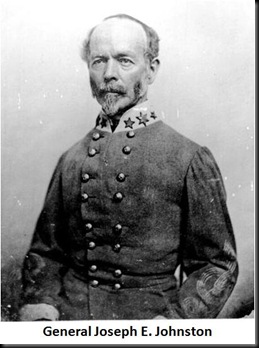
 Of all the men who held major commands during the Civil War, Joseph E. Johnson’s performance is, without doubt, the most perplexing. At the outset of the war, as a brigadier general in the Regular Army, he was the highest ranking officer to resign in favor of service to the Confederacy. He was also a man deeply respected by his peers and he retained that high stature throughout the war and into the years beyond it. He fought with distinction against the Seminole, Fox, and Sac Indians, and received two brevet promotions for gallantry in Mexico, where he was wounded twice.
Johnston was also a man with a deep, almost dysfunctional sense of personal honor, who valued order and proper procedure above all else. And, he was also a somewhat ambitious man. However, unlike men like Joe Hooker, his ambition was more subtle, quiet and far less aggressive. Still, he demanded what he felt was due him as a matter of course and could become extremely petulant if he believed he had been slighted. However, despite these apparent flaws, he was talented soldier of whom Ulysses S. Grant later said, when comparing him to other Confederate generals, “Joe Johnston gave me more anxiety than any of the others.” Further, those who served with him shared an equally high opinion. J.E.B. Stuart referred to Johnston as his best friend and James Longstreet once stated that he longed to serve under Johnston.
 However, those high opinions would not be shared by President Jefferson Davis. Although, at the outset of the war, Johnston was a man Davis sought out, elevated to command, and the two seemed to have common strategic vision. But, once Johnston took the field, their relationship changed and not for the better. Davis quickly discovered that, when he gave Johnston the latitude and discretion the Confederate president thought this highly experience general deserved, Johnston would become frozen and demand detailed instructions. At the same time, however, when detailed policy directives were issued, Johnston would become incensed at what he saw as excessive interference in his ability to command.
Johnston and Davis’ relationship would permanently sour over the issue of rank and, more specifically, Johnston’s rank relative to other Confederate generals. Following a maze of guidance issued by the Confederate Congress, Johnston was promoted to the full rank of general, but he was ranked fourth in terms of seniority behind Samuel Cooper, Albert Sidney Johnston, and Robert E. Lee. Johnston was incensed by this perceived slight. He wrote an angry two thousand-word note to President Davis in which he argued that, as the highest ranking officer in the U.S. Army to enter Confederate service, he should be the highest in seniority. In point of fact, for a variety of complex reasons related to the guidance from congress, Davis was correct in ranking Johnston fourth and tried to explain this to him. But, Johnston took the matter very seriously and even after the dates of rank were adjusted, Johnston was still angry with Davis. He would later make matters worse by openly allying himself with politicians such as Senator Louis Wigfall of Texas, who was a bitter opponent of Davis. As a result, their personal relationship would never recover.
In addition, Johnston began to display his limitations as a general. In early 1862, Johnston commanded the forces that would eventually be named the Army of Northern Virginia. As such, he was opposed by General George McClellan and the Army of the Potomac, and was responsible for the defense of northern Virginia and the capital at Richmond. However, when McClellan moved his army to the Virginia Peninsula, Johnston’s sole response was to fall back to a line near the capital’s defenses and await further developments. When Davis and Lee, who was now commander of all Confederate armies, inquired as to what was Johnston’s strategic plan for countering McClellan, Johnston replied that he planned to take the defensive and see if McClellan made an error that could be exploited. Given McClellan’s superior numbers, one can see the logic of this approach, but, at the same time, it seemed a recipe for accepting potential defeat before there had even been a fight. Johnston was eventually prodded to move on the offensive, had some limited success, but was severely wounded in the process. This led to Lee taking command of what would become his army, while Johnston spent several months recovering from his wounds.
Despite the souring of their relationship, Jefferson Davis continued to have respect for Johnston and his military abilities. Therefore, in late 1862, when the general fully recovered from his wounds, Davis appointed him commander of all Confederate armies in the western theater. In Davis’ opinion, Johnston was clearly a more talented and experienced officer that either the two army commanders in the theater, Braxton Bragg and John Pemberton. Therefore, Johnston would be charged with developing and implementing operational strategies, and ensuring cooperation between the two armies. Further, whenever a Federal army would move against either Bragg or Pemberton, Johnston would be on the scene, develop a response, and then leave the army commander to implement it. On the surface, it seemed like the perfect job for a man of Johnston’s perceived talents.
Unfortunately, the concept failed in execution for two reasons. First, in Davis’ mind, any Federal attacks would occur in isolation, allowing Johnston to deal with either Grant or Rosecrans’ army in turn. He never imagined they would pose a threat simultaneously. Therefore, while Johnston favored consolidating both armies into one and opposing the greater Federal threat, Davis insisted that the armies remain separate and that they give up as little Confederate territory as possible. Additionally, the concept failed because Johnston could not grasp what his job really entailed. In his mind, if he responded to a Federal threat to either Bragg or Pemberton and developed a plan for their implementation, he was interfering in their rights as army commanders, which he saw as supreme. That is one reason why he preferred to unify the two armies under his command. That way, he would be the “army commander” and, therefore, any command decisions he made would be appropriate. Joe Johnston simply did not have the vision to achieve what Davis sought.
As a result, when Grant moved against Pemberton at Vicksburg while Rosecrans was pressuring Bragg, only disaster could result. In many ways, Johnston’s response to Grant’s campaign was appropriate. He first attempted to distract and even block Grant with forces taken from Bragg, but he did not have the strength to do so effectively. Then, he urged Pemberton to evacuate Vicksburg and break through Union lines so they could join forces. In Johnston’s mind, losing Vicksburg was a fait accompli. Therefore, what mattered most was the preservation of Pemberton’s army so it could continue the fight. Unfortunately, however, Davis had personally ordered Pemberton to hold the city at all costs, leading to the loss of an army of 30,000 men.
 The loss of Vicksburg led to an end of Johnston’s command but he was soon thrust back into command when Bragg was defeated at Chattanooga in November 1863. Johnston was given command of the Army of Tennessee and told to defend the city of Atlanta from William T. Sherman’s advancing army. Johnston, once again, saw himself badly outnumbered and felt that he had no option but to be on the defensive. As a result, he spent the summer of 1864 fighting a war of maneuver against Sherman. Whenever the Union general shifted his forces in attempt to flank Johnston, Johnston would quickly move to block him. Except for the disastrous Union assault at Kennesaw Mountain, Sherman respected the defenses blocking him and continued to try to work his way around them. However, in executing this war of defensive maneuver, Joe Johnston was steadily falling back towards the city of Atlanta.
In Jefferson Davis’ mind, the loss of Atlanta was simply unacceptable, while, in Johnston’s mind, the preservation of the Army of Tennessee ranked highest. If he took the offensive, the army would be defeated with massive losses and Atlanta would still fall. Then, there would be no army capable of stopping Sherman from continuing an advance into the heart of the Deep South. However, Davis was always of an offensive mindset and he believed only violent, determined counterattacks would stop Sherman. Once again, the president and Joe Johnston were at odds.
Davis formally asked Johnston to detail his plan for dealing with Sherman, looking for some sense f that he would go on the offensive and, even more so, that Johnston would guarantee the safety of Atlanta. Johnston’s response gave him neither and Davis replaced him with the very offensive-minded John B. Hood. Hood would attack Sherman, as Davis desired, and the Army of Tennessee would be soundly smashed and Atlanta would fall, just as Johnston knew it would.
 In the closing months of the war, Johnston was again given command of the tattered remnants of the Army of Tennessee. He would try in vain to first slow down Sherman as the Union army ploughed through the Carolinas and then to join with Lee’s Army of Northern Virginia. When he heard of Lee’s surrender at Appomattox, he surrendered his army to Sherman at Bennett Place, North Carolina. He was so moved by Sherman’s kindness in issuing 10-days of rations to Johnston’s starving army, he would never allow anyone to speak ill of the Union general in his presence.
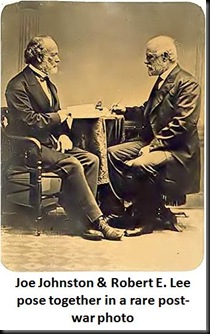 Johnston went on to success in the private sector following the war, served in the 46th U.S. Congress, and was a commissioner of railroads during the Grover Cleveland administration. But, his wartime record remains a disappointing and confounding puzzle. But, his sense of honor, which seems to have ruled so much of his behavior, provides a fascinating postscript to his career and his life. Johnston never forgot William T. Sherman’s magnanimity when he surrendered in April 1865.When Sherman died, Johnston served as a pallbearer at the funeral and, despite the cold, rainy weather during the procession in New York City, Johnston kept his hat off as a sign of respect. One bystander, who was concerned for the elderly general's health, asked him to please put on his hat. Johnston replied, "If I were in his place and he standing here in mine, he would not put on his hat." Within a few days, he became gravely ill with pneumonia and died on March 21, 1891.


 Posts
Posts


