Showing posts with label Overland Campaign. Show all posts

Sunday, June 21, 2009

Into the Wilderness

In spring 1864, Ulysses Grant assumed command of all the armies of the United States and implemented a grand strategy designed to attack the Confederacy on all fronts. A key role in that strategy fell to the Army of the Potomac, whose mission, in the words of Grant himself, was simply this: “Lee's Army will be your objective point. Wherever Lee goes there you will go also.” The first engagement of this campaign would take place in a dark, forbidding forest known as “the Wilderness,” and, while the battle itself might be characterized as essentially a draw, the two days of fighting there would paint an indelible and horrific portrait in the minds of many Union soldiers. When reading their letters, diaries, and memoirs, one gains a distinct impression that this battle, out the many they may have fought, left deeper and darker impressions. The descriptions are more vivid, more emotional, and more terrifying than those of any other battle of the Army of the Potomac. So, I am going to sample some of the stories I have encountered in my research and share a few Union soldiers’ memories of the Wilderness with you.

Winter Camp-Army of the Potomac As late April and early May 1864 arrived, the Army of the Potomac was at last stirred from its long winter rest. The logistics trains were made ready and the preparations to break winter quarters began. Grant had asked that the wagons which would make up the army’s supply train be made as small as possible, as speed was critical in his mind. “What I would direct then,” he told Meade in an April 9 letter, “is that you commence at once reducing baggage to the very lowest possible standard. Two wagons to a regiment of five hundred men is the greatest number that should be allowed for all baggage exclusive of subsistence stores and Ordnance stores.”

Grant’s thinking was probably that he would drive this army as he had his forces in the West. During the Vicksburg campaign, when he boldly ran the guns guarding the city on the Mississippi to land his troops south of the city, he abandoned the constraints posed by lines of supply and had his army live off the land. Moving swiftly, they crisscrossed the state of Mississippi in only 12 days. However, Grant would soon discover that, as far as moving rapidly on the march, the Army of the Potomac was, perhaps, not made of as stern a stuff as the lean, hard men he had commanded in the West. Plus, the army’s thinning ranks were now being supplemented by conscripts and new recruits, none of whom were experienced campaigners. They were almost certain to be slower on the march than hardened veterans.

Grant had decided that he would move by Lee’s right flank, which would allow the army to be resupplied via the York and Pamunkey Rivers. His plan was to swiftly move past Lee’s army, entrenched along the Rapidan, and get between the Army of Northern Virginia and Richmond, forcing Lee to come out and fight in the open, or fall back into the fortifications around the Confederate capital.

Wilderness TavernThe route selected by Grant required that Meade’s army cross an area of dense forest and tangled undergrowth known appropriately as the Wilderness. The army had been in this unforgiving region before, having fought Lee unsuccessfully a year earlier at Chancellorsville, which lay on the northern boundary of the forest. The biggest challenge to any army transiting the Wilderness was the absence of good roads. The impenetrable forest was crossed from a generally north to south direction by the Germanna Plank Road, which intersected first the east to west route of the Orange-Fredericksburg Turnpike at the Wilderness Tavern before coming to a stop at its juncture with the perpendicular course of the Orange Plank Road. The other north to south thoroughfare was the Brock Road, which began just east of the Wilderness Tavern, crossing the Germanna Plank Road just north of its intersection with the Orange Plank Road, then continued south, towards Spotsylvania.

On May 2, 1864, Meade’s staff issued detailed marching orders for the Army of the Potomac, informing the corps commanders that the movement against Lee would begin at 2 a.m. on the morning of May 4. Led by Sheridan’s cavalry, who would begin moving towards the Rapidan on May 3, the infantry would cross the Rapidan at Germanna Ford beginning with two divisions of Warren’s V Corps. They were to move by the Germanna Plank Road and Orange-Fredericksburg Turnpike to the vicinity of Parker’s Store, with the VI Corps following close behind. Hancock’s II Corps, meanwhile, would cross the river at Ely’s Ford, move quickly east towards Chancellorsville, then turn south to link up with the remainder of the army. Finally, Burnside’s IX Corps, would move to Germanna Ford and follow the main force into the Wilderness. Grant was planning for both surprise and speed, However, as events would prove, he would get neither.

As these orders came down to begin the great movement south, the Army of the Potomac’s camps became beehives of activity. Captain Lemuel Abbot, a 22-year old officer serving with the 10th Vermont Infantry regiment, recalled, “A part of the army moved to-day, and no doubt we shall go tomorrow; received orders at 6 o'clock p.m. to march at 4 o'clock a.m. tomorrow. All is confusion in camp.” Meanwhile, Captain Augustus Brown of Company H, 4th New York Heavy Artillery, noted the events in his diary:

Received orders after ‘’taps,” about 10 o’clock, to-night to be ready to move in two- hours. Rumors of all kinds are flying about, and the general impression seems to be that the whole army is in motion. I directed Sergeant Theben to turn out the company, strike tents and pack up, which was accomplished in less than the time allotted. But one wagon is detailed to furnish transportation for the effects of the whole battalion, so baggage is reduced to the minimum, and large quantities of ordnance stores and camp and garrison equipage, as well as private property of officers and men, are left behind strewn over the camping ground, a striking illustration of the waste of war.

Color Sgt. Daniel Crotty The recollections of some of the soldiers indicates excitement and even hope. Daniel Crotty, Color Sergeant of the 3rd Michigan Infantry, wrote he hoped that, as they left their camps, the army had “beat our last retreat” and that, “We file out of our late camps, all hoping never to return to them again.”

At 1:50 p.m., Grant telegraphed General Halleck to tell him that the army was across the Rapidan. He added that “Forty-eight hours now will demonstrate whether the enemy intends giving battle this side of Richmond.” A few minutes later, Grant received word from Meade that Union signal officers had intercepted a message sent to General Ewell that clearly indicated that the Confederates were moving out of their entrenchments. Porter recalled that Grant “manifested considerable satisfaction at receiving this news.” He then immediately sent a dispatch to Burnside, telling him to make forced marches to get to the crossing as soon as possible.

The Army of the Potomac crosses the Rapidan RiverAs the army marched towards the Rapidan, the weather was increasingly warmer and decidedly spring-like, which seemed to buoy many soldiers’ sprits. George T. Stevens, the Commanding Surgeon of the77th New York Infantry, wrote that, “It was a lovely day, and all nature seemed rejoicing at the advent of spring. Flowers strewed the wayside, and the warble of the blue bird, and the lively song of the sparrow, were heard in the groves and hedges.” Reading that, one would not have thought that Stevens and his comrades were marching into hell itself.

One thing that several soldiers noted was the roadside to and beyond the Rapidan being strewn with clothes, boots, and other supplies. In all likelihood, the many new, young recruits were learning that one simply could not carry all the Army issued you into battle. So, as the day grew warmer and the loads began to feel even heavier, soldiers simply cast off the excess. Seventeen-year old Private Frank Wilkerson, who was himself a new recruit to the 11th New York Light Artillery, remembered following a German immigrant regiment as it unloaded its extra equipment to his unit’s advantage:

We crossed the Rapidan on a pontoon bridge, and filled our canteens and drank deeply as we crossed. Then we marched over a narrow strip of valley land; then came a long, steep hill that led up to the comparatively level tableland of the Wilderness. This was the hill that caused the Germans to part with their personal property. Spare knapsacks, bursting with richness, were cast aside near its base. Blankets, musical instruments, spare boots, and innumerable articles of doubtful utility outcropped about half way up the hill. This float sharply indicated that the lead, when we discovered it, would be a rich one. Near the top of the hill we found many well-filled haversacks, and we picked up every one of them and hung them on the limbers and caissons and guns. The mine was rich, and we worked it thoroughly.

John Billings, a veteran soldier in the 10th Massachusetts Artillery, remembered encountering a massive amount of discarded supplies while enroute to the Wilderness:

It is growing warmer. The column has now got straightened out, and for the last hour has moved forward quite rapidly. The road is evidently clear of all obstructions, but the heat and speed begin to tell on the men. Look at the ground which that brigade has just vacated after its brief halt for rest. It is strewn with blankets, overcoats, dress-coats, pantaloons, shirts -- in fact, a little of everything from the outfit of the common soldier. As the Second Corps advanced into the Wilderness on the morning of May 4, 1864, I saw an area of an acre or more almost literally covered with the articles above named, many of them probably extras, but some of them the sole garment of their kind, left by the owners, who felt compelled, from the increasing weight of their load, to lighten it to the extent of parting with the blankets which they would need that very night for shelter. This lightening of the load began before the columns had been on the road an hour. A soldier who had been through the mill would not wait for a general halt to occur before parting with a portion of his load, if it oppressed him; but a recruit would hang to his until he bent over at an angle of 45° from a vertical, with his eyes staring, his lower jaw hanging, and his face dripping with moisture. If you were to follow the column after, say, the first two miles, you would find various articles scattered along at intervals by the roadside, where a soldier quietly stepped out of the ranks, sat down, unslung his knapsack or his blanket-roll, took out what he had decided to throw away, again equipped himself, and, thus relieved, hastened on to overtake the regiment. It did not take an army long to get into light marching order after it was once fairly on the road.

Unbeknownst to Grant, Lee had been anticipating a spring offensive by the Army of the Potomac, and Confederate scouts on Clyde’s Mountain observed movement in the Union army camps on the night of May 3-4, and then could clearly see the Federals moving across the river the next morning. As soon as Lee heard the news, he issued orders to General Ewell to move his corps rapidly east down the Orange-Fredericksburg Turnpike while Hill and Longstreet’s Corps would follow, moving via the Orange Plank Road. Lee planned to blunt this offensive as quickly as he could and he knew that the Union advantage in manpower would be mitigated by the terrain in the Wilderness and that the prowess of the Federal artillery could not be brought to bear effectively in the dense forest—the odds would be evened.

Had the Army of the Potomac moved as Grant had hoped, they would be out of the Wilderness before Lee could make contact. However, by nightfall on May 4, Warren’s corps had barely made it to Wilderness Tavern, Sedgwick’s VI Corps was strung out on the road behind him all the way back to Germanna Ford, Hancock’s men were still at Chancellorsville, and Burnside was not yet across the Rapidan. As darkness fell, the Union army made camp, and Lee quickly closed the distance from the west, making a collision inevitable.

During the night, young Private Wilkerson’s battery, which was part of Hancock’s II Corps, was camped on the old battlefield at Chancellorsville. Wandering about, they soon discovered shallow graves everywhere, containing the pathetic remains of men who would have been their comrades. The experience and the conversations around the campfire with veterans were unnerving for the young soldier:

It grew dark, and we built a fire at which to light our pipes close to where we thought Jackson's men had formed for the charge, as the graves were thickest there, and then we talked of the battle of the preceding year. We sat on long, low mounds. The dead were all around us. Their eyeless skulls seemed to stare steadily at us. The smoke drifted to and fro among us. The trees swayed and sighed gently in the soft wind. One veteran told the story of the burning of some of the Union soldiers who were wounded during Hooker's fight around the Wilderness, as they lay helpless in the woods. It was a ghastly and awe-inspiring tale as he vividly told it to us as we sat among the dead. This man finished his story by saying shudderingly: "This region," indicating the woods beyond us with a wave of his arm, "is an awful place to fight in. The utmost extent of vision is about one hundred yards. Artillery cannot be used effectively. The wounded are liable to be burned to death. I am willing to take my chances of getting killed, but I dread to have a leg broken and then to be burned slowly; and these woods will surely be burned if we fight here. I hope we will get through this chapparal without fighting," and he took off his cap and meditatively rubbed the dust off of the red clover leaf which indicated the division and corps he belonged to. As we sat silently smoking and listening to the story, an infantry soldier who had, unobserved by us, been prying into the shallow grave he sat on with his bayonet, suddenly rolled a skull on the ground before us, and said in a deep, low voice: "That is what you are all coming to, and some of you will start toward it to-morrow."

Capt. Henry Cribben As the Army of the Potomac camped that night, some men got their first look at the Wilderness. Captain Henry Cribben of the 140th New York Infantry was encamped near Wilderness Tavern and described it as follows:

The ground was covered with a thick mass of trees and underbrush in the vicinity of our position, which became denser to the north and west until it formed one compact mass of trees, underbrush and intertwining wild grapevines, stretching from tree to tree like large ropes, making it almost impossible for men or animals to pass, and very difficult to communicate from one part of the battlefield to another. The ground was rough, uneven and swampy to our right, with many small ravines or water courses, many of which were dry at the time…

The morning of May 5 began with Meade’s issuing orders to resume the march south. Sheridan’s cavalry was to keep moving out ahead the army, while Warren’s V Corps continued towards Parker’s Store and Hancock’s II Corps moved down the Cartahpin Road to Shady Grove Church, which would put them the furthest south. Sedgwick, meanwhile, was ordered to bring the VI Corps to the Old Wilderness Tavern, leaving a guard at Germanna Ford until Burnside’s corps arrived. Once everyone had reached their assigned destination, the entire army would continue moving south.

Battle of the Wilderness-May 5, 1864Map image used with permission by the Civil War Preservation Trust

May 5 dawned hot with an oppressive humidity. As the army began to move again, Captain Josiah Favill, 57th New York Infantry wrote that it was, “Very hot, and both men and animals suffered much.” The march began quietly, but that did not last long. At 7:30 a.m., Confederate forces appeared in front of Warren along the Orange-Fredericksburg Turnpike. Meade ordered Warren to attack them and then told Hancock to not proceed past Todd’s Tavern in case his men were needed. At first, Meade believed that this was nothing more than a delaying action by a small force and not a major force intent on giving battle. Grant told Meade, “If any opportunity presents itself for pitching into a part of Lee's army, do so without giving time for disposition.” Within hours, the battle would begin in earnest along the turnpike between Warren and Ewell’s corps. Lee had hoped to avoid a general engagement until Hill and Longstreet could come up, but the collision between the two opposing armies had made that impossible. As they moved forward, Henry Cribben’s regiment could see that something was happening:

…at daylight rumors were afloat that the enemy had been found in force in our immediate front, and the activity of mounted staff-officers and orderlies, riding up and down the road, showed signs of the coming conflict; and looking westward on the turnpike we could see men passing from one side of the road to the other less than a mile from our position.

140th New York Infantry in the Wilderness The initial fighting took place in a blind, groping manner, with soldiers crashing into the dense forest undergrowth, firing wildly, losing contact with the units to either side. Officers could not effectively maintain any control and the battle quickly turned into a series of disorganized brawls. Cribben’s regiment was almost immediately put into the line of battle and he remembered the fighting as being confused and disorienting:

…sometimes we found the woods so thick in out front that we could not see the enemy, although many of them were not more than fifteen or twenty feet distant. Often the burning powder from the discharged rifles in the hands of the enemy would drop at the feet of our men, who would instantly thrust their rifle bayonets through the brush and vines and kill or wound those in their front. The men could not see the effect of the thrust, but could hear the enemy yell with pain when they received the bayonet wound.

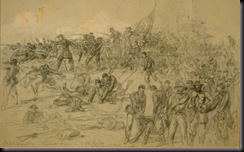
Fighting in the Wilderness Warren was able to turn Ewell back, but then Ewell countered against Warren’s left flank, forcing him back. Both sides finally pulled back, entrenched, and waited for someone to make the next move. As the afternoon began, both sides eyed each other warily along the turnpike. But, further south, Hancock had moved his corps to the intersection of the Brock and Orange Plank Road, lining up on General Getty’s left. At 4 p.m., Getty and Hancock attacked the lead elements of Hill’s corps, at first driving them back in confusion. However, they too soon found their attacks blunted by both the confusion of tangled, dense thickets and a Confederate counterattack. The soldiers on this portion of the Union front found themselves in similar circumstances as those of Henry Cribben and V Corps. Favill’s regiment was sent in to attack Hill’s corps and he remembered:

Presently we were ordered to move forward and attack through the woods, with two of our brigades, Brooke and Smith. They were soon across the breastworks, struggling with the interminable undergrowth, where it seemed impossible to keep any kind of alignment, yet we did, especially Brooke, who advanced nearly six hundred yards and immediately became engaged with the rebels who lay hid from view in front. The fighting on the right was severe, and several times reinforcements were sent from our part of the line to assist. Whilst the fighting in the woods in front was in progress, the staff were kept riding between them and the main road, a most difficult, dangerous, and disagreeable duty; not only was it almost impossible to ride a horse through the labyrinth of undergrowth, but one could only keep his direction by the sound of the firing. The woods were full of smoke, in many places on fire, and nothing could be seen twenty yards ahead. On one occasion I should have ridden directly into the enemy's lines but for Colonel Striker, of the Second Delaware, who saw me in front of his line just in time to call me back. I supposed I was riding in exactly the opposite direction to what I really was. Boots and clothes were torn to pieces and the horses became frantic.

For his part, young Captain Abbot had an even more unsettling experience:

Soon, however, we turned to the left or southerly into the woods and formed line of battle almost as soon as there was room after leaving the road with the enemy close in our front with a field piece of artillery hardly a hundred yards away through the brush which kept each from seeing the other. Before Captain H. R. Steele had hardly finished dressing his company after forming line a shell from this gun exploded in the ranks of Company K, killing a private and wounding others. The shell had burst actually inside the man completely disemboweling and throwing him high in the air in a rapidly whirling motion above our heads with arms and legs extended until his body fell heavily to the ground with a sickening thud. I was in the line of file closers hardly two paces away and just behind the man killed. We were covered with blood, fine pieces of flesh, entrails, etc., which makes me cringe and shudder whenever I think of it.

As darkness came, the fighting began to die down and both sides encamped for the night. With sunset, however, the fear of fire became foremost in many men’s minds, especially the wounded. Frank Wilkerson would write that:

The wounded soldiers lay scattered among the trees. They moaned piteously. The unwounded troops, exhausted with battle, helped their stricken comrades to the rear. The wounded were haunted with the dread of fire. They conjured the scenes of the previous year, when some wounded men were burned to death, and their hearts well-nigh ceased to beat when they thought they detected the smell of burning wood in the air. The bare prospect of fire running through the woods where they lay helpless, unnerved the most courageous of men, and made them call aloud for help. I saw many wounded soldiers in the Wilderness who hung on to their rifles, and whose intention was clearly stamped on their pallid faces. I saw one man, both of whose legs were broken, lying on the ground with his cocked rifle by his side and his ramrod in his hand, and his eyes set on the front. I knew he meant to kill himself in case of fire--knew it as surely as though I could read his thoughts.

Battle of the Wilderness-May 6, 1864Map image used with permission by the Civil War Preservation Trust

The morning of May 6 began even hotter than the day before, and Grant ordered an assault by all three Federal corps. Warren and Sedgwick attacked from the right down the Turnpike, while Hancock assaulted Hill’s corps on the Orange Plank Road. During the night, at around 2:00 a.m., Grant had also ordered Burnside to move to the Federal center and fill the gap between Warren and Hancock. However, when the attacks began at 5:00 a.m., Burnside’s men were still trying to make their way through the tangled underbrush and forest between the two Union corps, where there were no roads to assist them.

As for the fighting itself, the day became one of a combination of bloody stalemate, resounding success, and near disaster for Federal forces. First the attacks by Warren and Sedgwick on the Union right against Ewell failed to make any gains and their casualties were heavy. Within a few hours both corps had returned to their original positions and entrenched. Meanwhile on the Union left, Hancock’s II Corps drove A.P. Hill’s corps from the field and was on the verge of overrunning Lee’s headquarters near the Tapp Farm. Lee’s army was facing its greatest crisis since the late afternoon at Antietam in 1862, when Longstreet’s corps suddenly appeared. Hood’s old brigade from Texas counterattacked Hancock and drove the Union forces back. The two sides then continued to brawl in a series of bloody attacks that left a high casualty count on both sides. Daniel Crotty recalled his regiment’s attack on May 6 as follows.

The order comes to forward, and we go in, thinking, to surprise the Johnnies, but they are up and waiting for us in the thick chaparral. They pour a volley into our ranks, and the ball has commenced once more. Both sides stand and take the fearful fire, and the whole line seems to be one vast sheet of flame in the early morn. The number that fall on both sides is fearful, for we are fighting at very close range. We charge on their lines with great odds, but they stand their ground like a solid wall of masonry. The roar of musketry, the dying groans of the wounded, the hellish yells of the rebels, and the shouts and cheers of the Union men, mingle together, all making a noise and confusion that is hard to describe. Nothing is thought of but load and fire. The wounded must take care of themselves, and every man must stand and fight till either killed or wounded. The rebels fall in their line but those who fall have their places filled with a man in the rear. So they fall, one on another. Pretty soon those in the rear make breastworks of their dead comrades. We don't like this kind of fighting much, and forward on the charge in four or five lines deep. The rebels now give way and we chase them through the dense forest. We have to be very careful or we step on their dead and wounded, which lay around in thousands… My beautiful flag that looked as bright as a dollar we started, is fit now, after nearly two days' fighting, to send home, for it is completely riddled with bullets and torn by the brush. Nothing is done on this day but perfect slaughter on both sides, and at last night puts an end to sickening carnage.

Fires in the Wilderness Hancock’s losses were so severe that Grant cancelled a planned 6:00 p.m. attack by Hancock and Burnside, and ordered Hancock back to his breastworks along the Brock Road. While the fighting for the day had subsided, the night did not bring any relief. Crotty recalled, “The stench on this night is fearful, for the weather is very hot and the dead bodies, which lay around in thousands commence to mortify. We suffer fearfully, too, on account of the scarcity of water, and the sight of a mud-puddle pleasant indeed-we go for it like a drowning man catching at straws.” Further, the high temperatures and increased fighting resulted in everyone’s worst fear: fire. Brushfires began to break out all along the lines and the night of May 6 became one that would haunt many soldiers the rest of their lives. Horace Porter, a member of Grant’s staff, remembered the night as though it were a scene from Danté.

All circumstances seemed to combine to make the scene one of unutterable horror. At times the wind howled through the tree-tops, mingling its moans with the groans of the dying, and heavy branches were cut off by the fire of the artillery, and fell crashing upon the heads of the men, adding a new terror to battle. Forest fires raged; ammunition-trains exploded; the dead were roasted in the conflagration; the wounded, roused by its hot breath, dragged themselves along, with their torn and mangled limbs, in the mad energy of despair, to escape the ravages of the flames; and every bush seemed hung with shreds of blood-stained clothing. It was as though Christian men had turned to fiends, and hell itself had usurped the place of earth.

The next morning, Grant issued orders for the movement south, telling Meade, “Make all preparations during the day for a night march, to take position at Spotsylvania Court-House.” Under Grant’s order, Warren would move first, passing both Burnside and Hancock, and march south to Spotsylvania Court House. The march was to begin after dark, around 9:00 p.m., and the goal was to disengage quietly, move quickly, and surprise Lee.

With these orders, the Army of the Potomac was seeing something new. For the first time, they would not disengage from an offensive and withdraw after having given battle to Lee’s army. Grant was telling them that there would be no retreat, that this was going to be a campaign in the truest sense. As for the reaction of the average soldier, that was something most amazing. Despite what they had just been through, upon seeing Grant on horseback heading south, the men began to cheer, throwing their hats in the air, shouting in unison, “On to Richmond!” Porter remembered that, “Men swung their hats, tossed up their arms, and pressed forward to within touch of their chief, clapping their hands, and speaking to him with the familiarity of comrades.” Frank Wilkerson, was even more resolute in describing his and other soldiers’ opinion of Grant that night:

Grant's military standing with the enlisted men this day hung on the direction we turned at the Chancellorsville House. If to the left, he was to be rated with Meade and Hooker and Burnside and Pope -- the generals who preceded him. At the Chancellorsville House we turned to the right. Instantly all of us heard a sigh of relief. Our spirits rose. We marched free. The men began to sing. The enlisted men understood the flanking movement. That night we were happy.

Skeleton of a soldier killed in the Wilderness However, while Daniel Crotty would commend Grant for his pluck, he still saw little had been gained in the Wilderness, saying, “We do not see that there has been anything accomplished by the last three days' fighting, except a fearful slaughter of men.” Had he known what was coming at Spotsylvania and Cold Harbor, he might have been even more circumspect. Grant, meanwhile would see things differently, cabling General Halleck, “The results of the three days fight at Old Wilderness was decidedly in our favor. The enemy having a strong intrenched position to fall back on when hard pressed, and the extensive train we had to cover, rendered it impossible to inflict the heavy blow on Lee's army I had hoped.” Then, he concluded prophetically, “My exact route to the James River I have not yet definitely marked out.” And, as events would prove, neither had he marked out the cost.

Sunday, June 14, 2009

Cold Harbor: A Failure of Command

Gen. Ulysses Grant As much as the Union victory in the Civil War was a reflection of Ulysses Grant’s gifts as a commander, the Battle of Cold Harbor stands out as a product of his shortcomings. Grant’s strategic vision, tenacity, and ability to maintain his focus on the eventual goal would see the Army of the Potomac through the brutal summer campaign of 1864 and eventually allow the Union cause to be victorious. However, at the same time, his inability to create a workable command structure with that same army and his tendency to try to carry everything on his own shoulders, using his considerable strength and energy to inspire others, would cost the lives of thousands of Federal soldiers. Further, my great-great-great uncle, who served as a corporal in the 122d Ohio Infantry, was at the very center of the Union assault at Cold Harbor, and somehow survived the slaughter that ensued there. As a result, Cold Harbor has always held a special fascination for me. The blog entry that follows is based on research I did as a graduate student, which was later published in a condensed version.

Shortly after dawn on June 3, 1864, the Union Army of the Potomac launched a massive frontal assault against the Confederate Army of Northern Virginia at Cold Harbor, Virginia. This attack, intended to break the battered Confederate army and open the road to Richmond, would serve as the conclusion and the climax to Grant’s Overland Campaign against Robert E. Lee and the Army of Northern Virginia. The main part of the assault would take slightly less than an hour and, by some accounts, would cost nearly 7,000 Union casualties. In a war that had seen more than its share of uncompromising slaughter, Cold Harbor would stand alone.

Over the last few years, there has been a renewed interest in this tragic engagement, which, for many decades seems to have been overlooked when compared to the other major battles of Grant’s Overland Campaign. However, few analysts have focused attention on what may have been the root cause for this military disaster-the command process that surrounded the Army of the Potomac. Grant’s campaign during the summer of 1864 was highlighted by almost constant, hard, and desperate fighting. This style of warfare not only made incredible demands on the average soldier, it also had a severe impact on those in the chain of command and, as a result, the entire command process. In human terms, Cold Harbor was an utter catastrophe, and one that was the direct result of a flawed command process that had finally broken under the strain of battle. The decision to make the attack was based on poor information and invalid assumptions about the morale and military capabilities of the enemy. But, more so, the decision to launch the fateful assault and its execution reflected a total lack of command cohesion.

As related in the previous blog entry, Grant was promoted to the rank of Lieutenant General and the associated position of General-in-Chief of the Armies of the United States in March 1864. Once in his new position, Grant moved to execute a new grand strategy for defeating the Confederacy. He planned that, for the first time, all the Union armies would move in a coordinated fashion on all fronts. This would both prevent the Confederates from using their interior lines of communication to reinforce one another and, at the same time, place unrelenting military pressure on them. Essentially, Union forces would pound and hammer at the Confederate armies, inflicting losses in both men and supplies that they could ill-afford to sustain, while attacking the economic and social infrastructure of the South.

While Grant initially considered returning to the West to oversee the execution of his strategy, after arriving in Washington and observing the situation there, he felt that it was obvious that this was where the general-in-chief should be. However, not wishing to fall under the spell of political pressure and intrigue, Grant decided to conduct his command of the war from the field, alongside the Army of the Potomac. In Grant’s strategy, this army would have a vital mission: to engage Robert E. Lee and the Army of Northern Virginia, draw it into the open, and destroy it. In Grant’s mind, if Lee’s army was taken, Richmond would fall by default, and the war would rapidly come to a conclusion.

Gen. George Meade However, the Army of the Potomac posed many problems for Grant in terms of command. First, George Meade, commander of the Army of the Potomac and the victor at Gettysburg, had chafed under criticism from the administration and the press, as well as congressional investigations, all resulting from his decision to not pursue and destroy Lee’s army in the days following Gettysburg. He was seen as slow, overly cautious, and best when on the defensive—not the sort of man to execute Grant’s new strategy of hard, continuous campaigning. Further, the men who would be Meade’s four infantry corps commanders during the coming campaign were also somewhat suspect. The best of them, Winfield Scott Hancock, was a tenacious and talented fighter. But the wounds he received at Cemetery Hill on the final day at Gettysburg would not heal and, as a result, his health affected his ability to command. As for the others, Gouverneur Warren was a “complaining and uncooperative” commander, while Ambrose Burnside was mediocre at best. John Sedgwick, meanwhile, was steady and a solid leader, but his death at Spotsylvania a few days into the campaign would thrust Horatio Wright into a command position to which he was unaccustomed and for which he was unprepared.

Given this unsettling picture and the fact that the Army of the Potomac carried a reputation as being commanded by gentlemen politicians, perhaps it is little wonder Grant elected to ride into his grand campaign firmly joined at their hip. Their part of the great campaign was vital and, perhaps, Grant knew he could ill afford their slowness and history of turning back to regroup, rest, and resupply as soon as the first engagement was concluded. So, when Grant arrived at Meade’s headquarters near Brandy Station on March 10, 1864, everyone, including Meade, expected the Army of the Potomac’s commander to be replaced. However, Meade came across to the new general-in-chief as a man of modesty, honesty, and true patriotism, and Grant elected to retain him as the army’s commander. This decision met with derision in some quarters, particularly the press. The renowned editor Horace Greeley visited Washington and demanded Meade’s outright removal. Upon hearing this, Grant replied that, if he ever spoke to Greeley, he would tell him “when he wanted the advice of a political editor in selecting generals, he would call on him.”

For his part, Meade was publicly supportive, courteous, and subordinate to Grant. Privately, he was not a happy man. His letters to his wife, while maintaining a correct military position, still showed his disappointment in Grant’s decision to remain in the field with the Army of the Potomac. His wife, in turn, urged him to resign and return home. Meade responded that she should be careful not to criticize Grant in public or indicate there was any problem. He was, after all, still in command of a major army and he would stay and do his duty.

However, in keeping Meade in his position and by placing himself so close to the Army of the Potomac, Grant was creating a command problem that would eventually result in calamity. The questions that naturally arose revolved around Meade’s actual role and how far would Grant go in directing the activities of the Army of the Potomac. Grant would later write that his concept was to make Meade’s position seem as much as possible as though Grant was in Washington and Meade was in the field—Grant would issue orders for the movement of the army to Meade, and Meade would execute them. In other words, Grant would issue broad directives for the maneuvering and conduct of the Army of the Potomac, as well as the other armies in other theaters, leaving the detailed tactical execution to Meade.

Grant writing dispatch at Massaponax-Church But, Grant’s actual words and conduct at the time indicated something entirely different. Horace Porter wrote that, when speaking to his staff, Grant indicated he would take a more “hands-on” approach. Porter said that Grant referred to the practice of sending his staff to “critical points of the line to keep me promptly advised of what is taking place” and that, when emergencies dictated, he wanted them to communicate his “views to commanders, and urge immediate action” without awaiting specific orders from himself. Further, he told them he would place his headquarters near Meade’s and “communicate his instructions through that officer.” This seems to indicate a role not restricted to merely broad strategic direction. As a result, the Army of the Potomac appeared to have two heads

The initial fighting in the Wilderness demonstrated how much Grant would become involved in the details of battle as opposed to issuing broad strategic direction. For example, on the evening of May 5th, Grant ordered an attack all along the line for 4:30 A.M. on May 6th. Meade responded that he had ordered the attack take place at that time, but suggested 6:00 A.M. might be better and adding “Should you permit this change, I will advise the corps commanders.” Grant responded through his staff that Meade could change the attack to 5:00 A.M. but not 6:00 A.M. It should have seemed obvious to the most casual of observers that this ridiculous process, wherein the general-in-chief and one of his major army commanders were trading dispatches on minor time adjustments, could not continue.

Grant and his staff In fact, some did see the absurdity of the situation but not as one might expect. Grant’s staff quickly began to lobby for the general to simply ignore Meade’s position and bypass him entirely in directing the campaign. Horace Porter recounts a heated discussion that took place among Grant’s staff after the Wilderness regarding Meade’s “somewhat anomalous position.” With Grant listening intently, they argued that vital time was being lost in transmitting field orders through an intermediary whose position was essentially “a false one.” Further, some stated that they believed Meade and his staff were modifying Grant’s instructions or that they were “elaborated as to change their spirit.” Finally, as the discussion became more heated, they characterized Meade as having an “irascible temper” which “often irritated officers who came in contact with him.”

As was often the case, Grant waited until the arguments were completed, and then his response was measured, as always. He said that, while the present situation was not totally satisfactory, Meade’s presence relieved him of many duties he would otherwise have to undertake if he were to take a more active role. However, Porter noted that, while Grant maintained this view throughout the war, after those discussions, he began to give even “closer personal direction in battle to the movements of the subdivisions of the army.”

Meade and his staff On the other side of the situation, Meade chaffed under Grant’s increasing control. While he was always calm, subordinate, and cooperative in Grant’s presence, Meade read the newspaper accounts of the campaign, which gave every credit to Grant, and began to resent the control that Grant and his staff were exercising. His temper became foul and he grew more abrasive with each day. On one occasion, Charles Dana made the mistake of reading to Meade a dispatch from General Sherman. In the message, Sherman told Grant that his army had engaged the enemy successfully, could now maneuver, and, if Grant could inspire the Army of the Potomac to do its share, success would be assured. Meade flew into a rage, stating to Dana, “Sir! I consider that dispatch an insult to the army I command and to me personally. The Army of the Potomac does not require General Grant’s inspiration or anybody’s else inspiration to make it fight!” He continued to brood over the dispatch and at dinner told Colonel Theodore Lyman, a member of his staff, that the Western army Grant had commanded was merely an “armed rabble.”

Not surprisingly, the staffs that surrounded these two respective officers felt even stronger about the situation. As has been shown, Grant’s staff had a very low opinion of Meade and did not hesitate to let Grant know their opinions. Meade’s staff, meanwhile, had little respect for Grant’s staff and, perhaps, even for Grant. Colonel Lyman wrote at length in his journal about the relationship between the two headquarters’ staffs and his biggest concern was not so much Grant’s treatment of Meade, but the lack of respect Grant and his staff showed toward their opponent, Robert E. Lee. Lyman said that, from the very beginning, he sensed an air of overconfidence among Grant’s staff, who “talked and laughed flippantly about Lee and his army.” To be certain, Grant fostered some of this attitude in an effort to remove the mystic spell Lee had on the Army of the Potomac. However, what was most troubling about this kind of talk was that, as the campaign continued and the army fought one brutal and bloody engagement after another, the disrespect and “big talk” grew into genuine overconfidence that began to impact Grant’s official assessments and command decisions.

Even following the brutal and inconclusive fighting at Spotsylvania, Grant’s enthusiasm, as well as those around him, was undiminished. On May 26th, Charles Dana reported to Secretary of War Stanton that the “Rebels have lost all confidence, and are already morally defeated” and that Stanton could be certain “the end is near as well as sure. Even though it was becoming apparent that Lee would not come out to fight in the open, Grant also reported his certainty that Lee and his army were near the end of their collective rope. On the same day that Dana was assuring Stanton of the impending end to Confederate resistance, Grant was telling General Halleck the same story stating that the Confederate army was “really whipped” and that “I may be mistaken, but I feel that our success over Lee's army is already insured. This miscalculation of Lee’s strength by Grant and his staff would prove to be a critical ingredient in the command failure that to disaster at Cold Harbor.

In the days immediately following Grant and Dana’s pronouncements that Lee’s army was near its end, Grant continued to shift the Army of the Potomac to the left, forcing Lee to remain between Federal forces and Richmond, while still attempting to get Lee to come out and fight the final climactic battle. However, Lee would not take the bait. As Grant crossed the Pamunkey and the North Anna Rivers, Lee kept shifting with him. On May 29th, Grant ordered Sheridan to reconnoiter to the left and probe for Lee’s right, as he suspected Lee might be trying to move past the Federal left flank.

On May 31st, Sheridan discovered Lee had indeed moved far to his right and had entrenched infantry and cavalry at the Cold Harbor crossing. Sheridan engaged the enemy forces and, after a hard fight, drove them out. However, his scouts told him that heavier Confederate forces were moving in, so he elected to withdraw. But, when Grant heard this news, the importance was apparent to him. Lee was, indeed extending to his right, trying to cut Grant off from the shortest route to the James River and, perhaps more importantly, his base of supply at White House. Grant would later write, “The enemy knew the importance of Cold Harbor to us, and seemed determined that we should not hold it.” Grant immediately ordered Sheridan to return to the crossing and “to hold the place at all hazards, until reinforcements could be sent to him.” Cold Harbor suddenly had become the pivotal point of the campaign.

What no one seemed to be able to see, however, was that things were about to start down a horrible spiral. The army was exhausted and so were its commanders. The army had been either moving or fighting the most vicious combat of the war for nearly four weeks. It was even affecting the stalwart Grant. One soldier remembered seeing the general on the morning of May 28th as the II Corps crossed the Pamunkey River and, perhaps, his recollection says much about the mental and physical state of Grant and the soldiers of the Army of the Potomac. He wrote that Grant “looked tired” and was “sallow.” Further, he recalled that Grant “gazed steadily at the enlisted men as they marched by, as though trying to read their thoughts, and they gazed intently at him. He had the power to send us to our deaths, and we were curious to see him. But the men did not evince the slightest enthusiasm. None cheered him, none saluted him.”

This mental and physical fatigue, the kind that only sustained combat can produce, combined with a command structure that still was not functioning smoothly and was so flawed it probably never could, was setting the stage for a massive collapse. With the news from Sheridan, Grant immediately began to issue a series of orders, which George Meade acted upon with great energy. While it is difficult to place a finger on the precise moment of change, it is apparent Meade would now try to play the role of the proactive tactical commander and that Grant would let him do it. The strategic decisions would be Grant’s but Meade would now attend to the details. Perhaps Grant realized the system he had been using was terribly cumbersome, or perhaps he thought Meade was now capable of tactically executing the campaign as Grant wanted it done. Whatever the reason, Meade was now tactically in control of his army.

Things got off to a terrible start. In order to respond to General Grant’s desire that Sheridan’s cavalry be reinforced, Meade ordered Horatio Wright’s VI Corps to pull out of the line and begin marching toward Cold Harbor. But the orders were slow in being relayed and, as a result, Wright did not get underway until after midnight on June 1st. Traveling on dark, dust-choked roads, the men made slow progress. In addition, because Meade had chosen the corps on the far right of the Union line, they were the furthest away from Sheridan’s position. They had to travel the entire length of the Army of the Potomac to get to Cold Harbor and the poor maps with which the army was operating slowed their movement even more.

Gen. William Smith Things were even more confused for the men of the XVIII Corps, led by the venerable General William F. “Baldy” Smith. Smith was known as a good, solid soldier and was a favorite of Grant’s. He also was a very forthright officer who never hesitated to say exactly what he thought. His corps was also ordered to move to Cold Harbor, but they were at White House and, since they had not yet entered the Army of the Potomac’s area of operations, Grant gave the order for their movement. However, Grant’s staff made an error in the orders and told Smith to move to the New Castle Ferry, not to Cold Harbor, and to form up next to VI Corps when he arrived there. Receiving the orders in the early morning hours of June 1st, Smith sensed their urgency and hurried his command forward without any breakfast. However, when he arrived at New Castle Ferry, he could not find the VI Corps since he was still some five or six miles away from Cold Harbor. Soon, an officer from Grant’s staff arrived and told him of the error. Smith moved his men out quickly but they did not arrive at Cold Harbor until the early afternoon.

With Sheridan’s men having been replaced by the exhausted infantry of Wright and Smith, Meade ordered Hancock’s II Corps to also pull out of the line and begin moving towards Cold Harbor. Shortly thereafter and to the surprise of many, Meade decided to order a frontal assault on the Confederate forces digging in opposite Smith and Wright. Perhaps he was trying to prove to Grant that he too could be an aggressive fighter. If Grant wanted a big push against Lee here, Meade would go ahead and try to give him one.

Between Wright and Smith’s corps, Meade had six divisions to use against the two Confederate divisions dug in opposite the crossing, so the military odds looked good. However, the infantry were tired from their forced marches and there had been only been time for a “hasty reconnaissance” of the ground in front of the Federal lines. At 4:30 P.M., the worn out infantry attacked. The fighting was fierce and the blue-clad infantry did manage to sweep over the enemy rifle pits and then seize the main Confederate trenches. But a strong Southern counterattack forced them back. It had been a useless bloodletting that did little except to provide some small reconnaissance on enemy strength and positions. Emory Upton wrote that it was an example of the poor generalship during the campaign and that the various corps commanders were “not fit to be corporals. Lazy and indifferent, they will not even ride along their lines; yet, without hesitancy, they will order us to attack the enemy, no matter what their positions or numbers.”

With nightfall, things in the Army of the Potomac became even more unsettled and Meade began to show signs of stress and fatigue. Theodore Lyman recorded that Meade “was in one of his irascible fits to-night.” Meade complained that Warren and his corps had pushed too far forward without orders, vented that Wright was too slow, and then said he wished the corps commanders would act for themselves and stop leaning on him. In the midst of all this ranting, an aide to General Smith arrived to report that his commanding officer was in serious need of ammunition and transportation, and that General Smith “considered his position precarious.” Using profanity he seldom uttered, a clearly exasperated Meade roared, “Then, why in Hell did he come at all for?”

Later, he instructed Smith to be ready for an early morning assault. However, Smith cautioned him that his command was not up to such an attack, terming the prospect “simply preposterous.” Soon, Meade discovered he had more problems than Smith’s concerns. Meade had been counting on the presence of the tough, hardened veterans of Hancock’s II Corps to mount the early morning attack. Unfortunately, their night march to Cold Harbor was going worse than that of Wright the previous evening. II Corps became hopelessly lost and, at one point, the engineer sent to guide them took the corps down a supposed short cut that proved to be so narrow, Hancock’s artillery could not use the road. As a result, his command was forced to backtrack and find another route, causing “great confusion.” As a result, Hancock’s troops would not arrive until 6:30 A.M.

Learning of Hancock’s lack of progress, at 12:30 A.M., Meade issued an order that the attack would be postponed until 5:00 P.M. on June 2nd. But all these delays were adding to another of the concerns that Meade expressed: Lee was getting the time to shift his forces and dig in. The ability of Lee’s army to quickly erect field fortifications was a skill that the Army of Potomac had seen demonstrated repeatedly.

Despite the delays, after discussing the issue with his key commanders, Grant still decided that attacking Lee in his present position was the best course of action. According to Horace Porter, Grant surmised that, first, he had broken the enemy at other places “under circumstances which were not more favorable” and that, if they could do so now, the results obtained would justify the decision. Porter also maintained that Grant viewed the decision to attack from a broader perspective and that the general was keenly aware that the Northern populace was becoming discouraged by the length of the war. Therefore, a decision at this point to maneuver south of the James River towards Petersburg would be seen as indefinite in nature and feed the population’s growing impatience.

Concerned that Hancock’s men were not up to an attack that afternoon, Grant advised Meade to delay the assault until the early morning hours of June 3rd. On the negative side, this decision resulted in more delay and provided yet more time for Lee’s army to entrench and reinforce. On the positive side, Meade’s order did direct commanders to conduct a reconnaissance of the ground in front of their positions. This not only would tell them the nature of the terrain between Union and the Confederate lines, but it also, hopefully, would aid in determining the makeup of the enemy’s fortifications. However, no such reconnaissance ever took place. This is one of the great command mysteries surrounding Cold Harbor. It seems inconceivable that experienced commanders would violate what any soldier, then or now, would see as a crucial element of battlefield preparation. It is of significance that, when Meade later relayed his orders to Burnside and Warren regarding their attacks on the Confederate left, he never reemphasized this need for reconnaissance. In fact, what is perhaps even more significant is that neither Grant, Meade, nor any of the corps commanders ever followed up to determine what results had been obtained from reconnaissance activities.

Hancock’s adjutant, Francis Walker, later wrote that there had been no opportunity to “make an adequate reconnaissance of the enemy’s line…it was, beyond question, the most unfortunate decision made during that bloody campaign.” The fact that Hancock’s adjutant made this comment is telling. Meade’s circular had been clear in that it stated commanders should use the additional time to examine the ground in front of them. So, why did Walker state that there had been no opportunity and why did no other commander make any effort at a reconnaissance? Time should not have been a problem since the circular went out at 2:30 P.M. and there was more than enough daylight left before nightfall to probe the Confederate positions.

Historian Bruce Catton maintains that it was merely assumed this reconnaissance would be done as a matter of routine. However, he states that corps routine in the Army of the Potomac “did not extend to such matters.” As a result, in Catton’s words, “40,000 men in three army corps were to begin marching towards Richmond at dawn. What they were going to run into along the way was something they would have to find out for themselves."

The only real reconnaissance was that made during the fighting late on June 1st, and much had probably changed. The heavy woods between the Union and Confederate positions limited the troops’ ability to even see the enemy positions. All that was known was that there was evidence that field fortifications had been prepared. Their nature, their orientation, and the strength of the enemy were totally unknown. So, all that could be seen was some turned earth and that was what they would attack. Unfortunately for the Army of the Potomac, the freshly dug earth they could see included rifle-pits, and not one main line of trenches, but two and even three in some places. Lee and his men had skillfully placed their fortifications so that they followed the uneven terrain and made maximum use of its natural characteristics.

The other odd thing about the planning for the assault was that each corps was seemingly left on its own to determine how it was going to attack, with no plans for cooperation. Smith said that the entire concept made it apparent to him that there was no semblance of a military plan involved. So, he sent a message to General Wright asking him to explain his plan of attack for VI Corps. Smith reasoned that, since VI Corps would be on his left, perhaps, he could do something to conform to their plan. To Smith’s shock and dismay, Wright replied that his plan was simply to “pitch in.” Therefore, Smith realized his only option was to do the same, charge straight ahead, and see what happened.

Colonel Charles Wainwright, who served in Sheridan’s cavalry at the time of the campaign, heard about the attack and the lack of planning in the days after the battle. He would comment in his diary that, “there was a still more absurd order issued, for each command to attack without reference to its neighbors, as they saw fit; an order which looked as if the commander, whoever he is, had either lost his head entirely, or wanted to shift the responsibility off his own shoulders.” Clearly, any remaining semblance of command cohesion was gone.

However, what some of the senior officers could not see, the average soldier could clearly comprehend. One soldier recalled that, “We knew that a bloody battle was close at hand, and instead of being elated the enlisted men were depressed in spirit.” Some of his comrades were “sad, some indifferent; some so tired of the strain on their nerves that they wished they were dead and their troubles over.” Their clear impression was that the task cut out for them was more than men could accomplish.

That night, as he toured the camps, Horace Porter observed something that has been often told about the night before the attack at Cold Harbor. It said much regarding what the average soldier knew about the next day’s fight and about what his commanders could not see. Porter reported that men were sewing their names and home addresses onto their uniform jackets so that, when they fell, their bodies could be recognized and their fate made known to their families at home.

Map of June 3rd Assault In the darkness preceding dawn of June 3rd, all five corps of the Army of the Potomac began to form up in a long, almost unbroken line. The concept for the attack was simple but without any solid military logic. The II, VI, and XVIII Corps would conduct the main attack on Lee’s right. Meanwhile, V and IX Corps under Warren and Burnside, respectively, would attack the left of the Army of Northern Virginia in order to hold the units there in place and prevent Lee from transferring them to help hold the right side of his line. The only coordination in this plan was that everyone would attack at 4:30 A.M.

1st Maine Heavy Artillery attack at Cold Harbor At the appointed time, a signal gun sounded, and the Army of the Potomac stepped off in a heavy mist and fog to attack Lee’s army. Within minutes, as the first wave moved forward, the heavy vegetation and previously unseen swamps and wetlands began to break up the neat formations and, even within each corps, any appearance of a coordinated attack disappeared. Thus, the assault quickly became a collection of uncoordinated, isolated, individual actions. Further, as the five corps moved forward and the Confederate fortifications came into view, each began to square up with the works at their front. Given the configuration of Lee’s lines and because they had not previously reconnoitered the ground, this caused the Union formations to depart off at odd angles from one another and each corps began to lose contact with the units next to them. As a result, when the Confederates opened fire, they were able to enfilade the Union attackers with devastating effectiveness.

Sketch of Barlow's men seizing Confederate works In a war that had seen more than its share of slaughter, Cold Harbor would set a new and terrible standard. The Union forces advanced under a storm for rifle and artillery fire, and the men went down in groups. In the course of the first hour, two waves went forward and only Francis Barlow’s division of Hancock’s corps actually met with success. They managed to seize and hold a portion of Lee’s far right. But here, again, command failed. Despite Barlow’s repeated requests, Birney’s division, which was in reserve, stayed where it was, and was never ordered to move forward to exploit what Barlow’s men had gained. The remaining four Union corps went forward, some getting further than others, until the withering fire from Lee’s entrenchments slowed, stopped, and eventually pinned the Federals down. The embattled soldiers simply dug in where they were and tried to survive.

Harper's Weekly depiction of the Battle of Cold Harbor Command communications were confused and there was no control over the attack. Meade and his staff were oddly disconnected from the battle because the woods filtered the noise of battle and, thus, they had no feel for what was happening. Theodore Lyman wrote, “There has been no fight of which I have seen so little as this. The woods were so placed that the sound, even of the musketry, was much kept away, and the fighting, though near us, was completely shut from view.” The reports that came into Meade’s headquarters conveyed a confused picture and, soon, the lack of prior planning and coordination became apparent. Each of the three corps commanders on the Union left now complained to Meade that the corps on his right or left had failed to protect him from enfilading fire. Meade’s curious response to this situation was to send copies of each corps commander’s complaint to the others. Meade kept trying to urge his commanders forward but they became increasingly insistent that nothing could be done. Hancock became especially exasperated with Meade’s requests to continue the assault, telling him “Unless success has been gained in other points, I do not advise persistence here.”

At 7:00 A.M., with attacks failing up and down the line, Meade sent Grant a message advising him that, ”I should be glad to have your views as to the continuance of these attacks, if unsuccessful." This dispatch, in some ways, seemed to indicate that Meade was surrendering his control back to Grant.

Grant replied quickly and stated what would seem to be obvious: “The moment it becomes certain that an assault cannot succeed, suspend the offensive, but when one does succeed push it vigorously, and if necessary pile in troops at the successful point from wherever they can be taken.” With that dispatch sent, Grant moved to Meade’s headquarters and, for all intents and purposes, once again took tactical control of the Army of the Potomac.

Grant had been nearby at his headquarters and was apparently receiving the same reports as Meade. In addition, his staff went out to ride the lines and gather information, which they funneled back to the general-in-chief. However, things were happening faster than they could report them. After moving to Meade’s headquarters, Grant decided to ride out to the lines himself and consult directly with Meade’s corps commanders. This action could leave no doubt as to who was now in command. Grant returned to Meade’s headquarters and, at 12:30 A.M., he issued an order suspending the assault: “The opinion of corps commanders not being sanguine of success in case an assault is ordered, you may direct a suspension of farther advance for the present. Hold our most advanced positions, and strengthen them.”

Later in the afternoon, an order would be sent out to try another assault, but the reaction it received varied. There were some isolated moves forward but they apparently amounted to nothing more than some brief heated exchanges of rifle fire. For his part, Baldy Smith flatly refused to obey the order and, interestingly, was never sanctioned for it. Finally, while some senior officers would deny it ever happened, there were units who simply refused to advance. One soldier witnessed this amazing event and later wrote, “The army to a man refused to obey the order, presumably from General Grant, to renew the assault. I heard the order given, and I saw it disobeyed." The common soldier had put in his vote and the battle for the crossing at Cold Harbor was over.

Grant’s initial report to General Henry Halleck, sent at 2:00 P.M., was shocking in its understatement of what had occurred:

We assaulted at 4.30 o'clock this morning, driving the enemy within his intrenchments at all points, but without gaining any decisive advantage. Our troops now occupy a position close to the enemy, some places within 50 yards, and are intrenching. Our loss was not severe, nor do I suppose the enemy to have lost heavily. We captured over 300 prisoners, mostly from Breckinridge's command.

However, the magnitude of what had occurred and the ghastly cost of this command blunder would soon become apparent. While the exact number of casualties has become an item of modern debate, no matter their total, it had been an unmitigated disaster. Theodore Lyman recorded that; “We gained nothing save a knowledge of their position and the proof of the bravery of our soldiers.” That night, Grant finally made his feelings known to his staff: “I regret this assault more than any one I have ever ordered. I regarded it as a stern necessity, and believed it would bring compensating results; but, as it has proved, no advantages have been gained sufficient to justify the heavy losses suffered.” With that said, as was his manner, Grant focused his energies on planning his next moves and seldom spoke of Cold Harbor again. However, the simplest and most telling description of the slaughter at Cold Harbor was made by Confederate General Evander Law who wrote to his wife after the battle that, “It was not war, but murder.”

There was a profound change at Grant’s headquarters following the June 3rd assault at Cold Harbor. Colonel James Wilson described it as a sense of despondency. Wilson said that Grant was deeply disappointed he had not been able to overwhelm Lee and was upset that his subordinates had not properly attended to the detailed planning required to carry out his orders. According to Wilson, Grant was now aware that, perhaps, this was being done so as to shift responsibility to him. In addition, his staff was now seeing the disastrous effects of the continuous use of frontal assaults and feared the army would come apart if this approach continued. One thing was certain: the cockiness that had been the hallmark of Grant’s staff when the campaign began was now gone and a numb sense of harsh reality had set in.

For his part, Meade seemed to take an entirely petulant attitude. In a meeting with Baldy Smith two days after the battle, he told his corps commander that he had worked out every plan for every move since the campaign began. He then complained about the newspapers being full of the activities of “Grant’s army” and that he was tired of it. He finished by saying that he was now “determined to let General Grant plan his own battles.” Smith wrote that, while he had “no knowledge of the facts,” he had “always supposed that General Grant’s order was to attack the enemy at 4:30 A.M. of the 3rd, leaving the details to his subordinates.” In other words, Smith believed that Meade simply did not try to execute Grant’s orders properly because he was angry about his treatment by Grant and by the press. Whatever Meade’s thinking had been, the result was that, at Cold Harbor, no one was in effective command of the Army of the Potomac.

The ultimate tragedy of Cold Harbor was that it was so avoidable. The Army of the Potomac did not fail on June 3rd. Rather, its leadership failed and failed miserably. Thousands of brave men died because an unworkable command system had been allowed to remain in place long after it was apparent that it was impractical. Worst of all, however, is that, as that structure broke down, so did professional conduct among its key officers.

Ulysses S. Grant should have seen the trouble coming. He had put a system in place wherein no one was quite sure who was in command of the Army of the Potomac. Then, he had complicated that picture through words and actions that indicated he was truly in command. Given the situation, perhaps there was nothing Grant could have done to have earned the trust of the Army of the Potomac’s leadership, but the actions of he and his staff made things worse than they should have been. For his part, George Meade, while subordinate in public, felt abused and seethed at the attention Grant got from the press. What he did not understand was that Grant paid little attention to such things as praise from the newspapers, and, perhaps, Grant did not realize how much it affected others. However, once given tactical control, Meade proved to be either, at best, incompetent or, at worst, guilty of gross professional negligence.

Then there are the actions of Hancock, Wright, and the other corps commanders at Cold Harbor. How could they let their men attack with no knowledge of lay ahead of them? With the exception of Baldy Smith, not one of them made even the slightest pretense of a protest. Perhaps it was stress, fatigue, and the fact these men simply had seen so much death, so many bloody frontal attacks, that they viewed this as just another order to be carried out no matter the cost. It was as though the attack was a terrible predestined act which none of them had the power to influence.

Burying the Union dead at Cold Harbor Cold Harbor was, indeed, a failure of command. It is a horrible example of what happens when command cohesion breaks down under the weight of an unworkable system, when the stress of battle overcomes professionalism, and when otherwise good officers forget the basics of command and their responsibilities as commanders. In the end, their men, the average soldiers, paid the ultimate and terrible price.