 As much as the Union victory in the Civil War was a reflection of Ulysses Grant’s gifts as a commander, the Battle of Cold Harbor stands out as a product of his shortcomings. Grant’s strategic vision, tenacity, and ability to maintain his focus on the eventual goal would see the Army of the Potomac through the brutal summer campaign of 1864 and eventually allow the Union cause to be victorious. However, at the same time, his inability to create a workable command structure with that same army and his tendency to try to carry everything on his own shoulders, using his considerable strength and energy to inspire others, would cost the lives of thousands of Federal soldiers. Further, my great-great-great uncle, who served as a corporal in the 122d Ohio Infantry, was at the very center of the Union assault at Cold Harbor, and somehow survived the slaughter that ensued there. As a result, Cold Harbor has always held a special fascination for me. The blog entry that follows is based on research I did as a graduate student, which was later published in a condensed version.
Shortly after dawn on June 3, 1864, the Union Army of the Potomac launched a massive frontal assault against the Confederate Army of Northern Virginia at Cold Harbor, Virginia. This attack, intended to break the battered Confederate army and open the road to Richmond, would serve as the conclusion and the climax to Grant’s Overland Campaign against Robert E. Lee and the Army of Northern Virginia. The main part of the assault would take slightly less than an hour and, by some accounts, would cost nearly 7,000 Union casualties. In a war that had seen more than its share of uncompromising slaughter, Cold Harbor would stand alone.
Over the last few years, there has been a renewed interest in this tragic engagement, which, for many decades seems to have been overlooked when compared to the other major battles of Grant’s Overland Campaign. However, few analysts have focused attention on what may have been the root cause for this military disaster-the command process that surrounded the Army of the Potomac. Grant’s campaign during the summer of 1864 was highlighted by almost constant, hard, and desperate fighting. This style of warfare not only made incredible demands on the average soldier, it also had a severe impact on those in the chain of command and, as a result, the entire command process. In human terms, Cold Harbor was an utter catastrophe, and one that was the direct result of a flawed command process that had finally broken under the strain of battle. The decision to make the attack was based on poor information and invalid assumptions about the morale and military capabilities of the enemy. But, more so, the decision to launch the fateful assault and its execution reflected a total lack of command cohesion.
As related in the previous blog entry, Grant was promoted to the rank of Lieutenant General and the associated position of General-in-Chief of the Armies of the United States in March 1864. Once in his new position, Grant moved to execute a new grand strategy for defeating the Confederacy. He planned that, for the first time, all the Union armies would move in a coordinated fashion on all fronts. This would both prevent the Confederates from using their interior lines of communication to reinforce one another and, at the same time, place unrelenting military pressure on them. Essentially, Union forces would pound and hammer at the Confederate armies, inflicting losses in both men and supplies that they could ill-afford to sustain, while attacking the economic and social infrastructure of the South.
While Grant initially considered returning to the West to oversee the execution of his strategy, after arriving in Washington and observing the situation there, he felt that it was obvious that this was where the general-in-chief should be. However, not wishing to fall under the spell of political pressure and intrigue, Grant decided to conduct his command of the war from the field, alongside the Army of the Potomac. In Grant’s strategy, this army would have a vital mission: to engage Robert E. Lee and the Army of Northern Virginia, draw it into the open, and destroy it. In Grant’s mind, if Lee’s army was taken, Richmond would fall by default, and the war would rapidly come to a conclusion.
 However, the Army of the Potomac posed many problems for Grant in terms of command. First, George Meade, commander of the Army of the Potomac and the victor at Gettysburg, had chafed under criticism from the administration and the press, as well as congressional investigations, all resulting from his decision to not pursue and destroy Lee’s army in the days following Gettysburg. He was seen as slow, overly cautious, and best when on the defensive—not the sort of man to execute Grant’s new strategy of hard, continuous campaigning. Further, the men who would be Meade’s four infantry corps commanders during the coming campaign were also somewhat suspect. The best of them, Winfield Scott Hancock, was a tenacious and talented fighter. But the wounds he received at Cemetery Hill on the final day at Gettysburg would not heal and, as a result, his health affected his ability to command. As for the others, Gouverneur Warren was a “complaining and uncooperative” commander, while Ambrose Burnside was mediocre at best. John Sedgwick, meanwhile, was steady and a solid leader, but his death at Spotsylvania a few days into the campaign would thrust Horatio Wright into a command position to which he was unaccustomed and for which he was unprepared.
Given this unsettling picture and the fact that the Army of the Potomac carried a reputation as being commanded by gentlemen politicians, perhaps it is little wonder Grant elected to ride into his grand campaign firmly joined at their hip. Their part of the great campaign was vital and, perhaps, Grant knew he could ill afford their slowness and history of turning back to regroup, rest, and resupply as soon as the first engagement was concluded. So, when Grant arrived at Meade’s headquarters near Brandy Station on March 10, 1864, everyone, including Meade, expected the Army of the Potomac’s commander to be replaced. However, Meade came across to the new general-in-chief as a man of modesty, honesty, and true patriotism, and Grant elected to retain him as the army’s commander. This decision met with derision in some quarters, particularly the press. The renowned editor Horace Greeley visited Washington and demanded Meade’s outright removal. Upon hearing this, Grant replied that, if he ever spoke to Greeley, he would tell him “when he wanted the advice of a political editor in selecting generals, he would call on him.”
For his part, Meade was publicly supportive, courteous, and subordinate to Grant. Privately, he was not a happy man. His letters to his wife, while maintaining a correct military position, still showed his disappointment in Grant’s decision to remain in the field with the Army of the Potomac. His wife, in turn, urged him to resign and return home. Meade responded that she should be careful not to criticize Grant in public or indicate there was any problem. He was, after all, still in command of a major army and he would stay and do his duty.
However, in keeping Meade in his position and by placing himself so close to the Army of the Potomac, Grant was creating a command problem that would eventually result in calamity. The questions that naturally arose revolved around Meade’s actual role and how far would Grant go in directing the activities of the Army of the Potomac. Grant would later write that his concept was to make Meade’s position seem as much as possible as though Grant was in Washington and Meade was in the field—Grant would issue orders for the movement of the army to Meade, and Meade would execute them. In other words, Grant would issue broad directives for the maneuvering and conduct of the Army of the Potomac, as well as the other armies in other theaters, leaving the detailed tactical execution to Meade.
 But, Grant’s actual words and conduct at the time indicated something entirely different. Horace Porter wrote that, when speaking to his staff, Grant indicated he would take a more “hands-on” approach. Porter said that Grant referred to the practice of sending his staff to “critical points of the line to keep me promptly advised of what is taking place” and that, when emergencies dictated, he wanted them to communicate his “views to commanders, and urge immediate action” without awaiting specific orders from himself. Further, he told them he would place his headquarters near Meade’s and “communicate his instructions through that officer.” This seems to indicate a role not restricted to merely broad strategic direction. As a result, the Army of the Potomac appeared to have two heads
The initial fighting in the Wilderness demonstrated how much Grant would become involved in the details of battle as opposed to issuing broad strategic direction. For example, on the evening of May 5th, Grant ordered an attack all along the line for 4:30 A.M. on May 6th. Meade responded that he had ordered the attack take place at that time, but suggested 6:00 A.M. might be better and adding “Should you permit this change, I will advise the corps commanders.” Grant responded through his staff that Meade could change the attack to 5:00 A.M. but not 6:00 A.M. It should have seemed obvious to the most casual of observers that this ridiculous process, wherein the general-in-chief and one of his major army commanders were trading dispatches on minor time adjustments, could not continue.
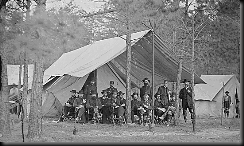 In fact, some did see the absurdity of the situation but not as one might expect. Grant’s staff quickly began to lobby for the general to simply ignore Meade’s position and bypass him entirely in directing the campaign. Horace Porter recounts a heated discussion that took place among Grant’s staff after the Wilderness regarding Meade’s “somewhat anomalous position.” With Grant listening intently, they argued that vital time was being lost in transmitting field orders through an intermediary whose position was essentially “a false one.” Further, some stated that they believed Meade and his staff were modifying Grant’s instructions or that they were “elaborated as to change their spirit.” Finally, as the discussion became more heated, they characterized Meade as having an “irascible temper” which “often irritated officers who came in contact with him.”
As was often the case, Grant waited until the arguments were completed, and then his response was measured, as always. He said that, while the present situation was not totally satisfactory, Meade’s presence relieved him of many duties he would otherwise have to undertake if he were to take a more active role. However, Porter noted that, while Grant maintained this view throughout the war, after those discussions, he began to give even “closer personal direction in battle to the movements of the subdivisions of the army.”
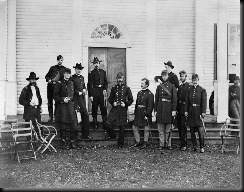 On the other side of the situation, Meade chaffed under Grant’s increasing control. While he was always calm, subordinate, and cooperative in Grant’s presence, Meade read the newspaper accounts of the campaign, which gave every credit to Grant, and began to resent the control that Grant and his staff were exercising. His temper became foul and he grew more abrasive with each day. On one occasion, Charles Dana made the mistake of reading to Meade a dispatch from General Sherman. In the message, Sherman told Grant that his army had engaged the enemy successfully, could now maneuver, and, if Grant could inspire the Army of the Potomac to do its share, success would be assured. Meade flew into a rage, stating to Dana, “Sir! I consider that dispatch an insult to the army I command and to me personally. The Army of the Potomac does not require General Grant’s inspiration or anybody’s else inspiration to make it fight!” He continued to brood over the dispatch and at dinner told Colonel Theodore Lyman, a member of his staff, that the Western army Grant had commanded was merely an “armed rabble.”
Not surprisingly, the staffs that surrounded these two respective officers felt even stronger about the situation. As has been shown, Grant’s staff had a very low opinion of Meade and did not hesitate to let Grant know their opinions. Meade’s staff, meanwhile, had little respect for Grant’s staff and, perhaps, even for Grant. Colonel Lyman wrote at length in his journal about the relationship between the two headquarters’ staffs and his biggest concern was not so much Grant’s treatment of Meade, but the lack of respect Grant and his staff showed toward their opponent, Robert E. Lee. Lyman said that, from the very beginning, he sensed an air of overconfidence among Grant’s staff, who “talked and laughed flippantly about Lee and his army.” To be certain, Grant fostered some of this attitude in an effort to remove the mystic spell Lee had on the Army of the Potomac. However, what was most troubling about this kind of talk was that, as the campaign continued and the army fought one brutal and bloody engagement after another, the disrespect and “big talk” grew into genuine overconfidence that began to impact Grant’s official assessments and command decisions.
Even following the brutal and inconclusive fighting at Spotsylvania, Grant’s enthusiasm, as well as those around him, was undiminished. On May 26th, Charles Dana reported to Secretary of War Stanton that the “Rebels have lost all confidence, and are already morally defeated” and that Stanton could be certain “the end is near as well as sure. Even though it was becoming apparent that Lee would not come out to fight in the open, Grant also reported his certainty that Lee and his army were near the end of their collective rope. On the same day that Dana was assuring Stanton of the impending end to Confederate resistance, Grant was telling General Halleck the same story stating that the Confederate army was “really whipped” and that “I may be mistaken, but I feel that our success over Lee's army is already insured. This miscalculation of Lee’s strength by Grant and his staff would prove to be a critical ingredient in the command failure that to disaster at Cold Harbor.
In the days immediately following Grant and Dana’s pronouncements that Lee’s army was near its end, Grant continued to shift the Army of the Potomac to the left, forcing Lee to remain between Federal forces and Richmond, while still attempting to get Lee to come out and fight the final climactic battle. However, Lee would not take the bait. As Grant crossed the Pamunkey and the North Anna Rivers, Lee kept shifting with him. On May 29th, Grant ordered Sheridan to reconnoiter to the left and probe for Lee’s right, as he suspected Lee might be trying to move past the Federal left flank.
On May 31st, Sheridan discovered Lee had indeed moved far to his right and had entrenched infantry and cavalry at the Cold Harbor crossing. Sheridan engaged the enemy forces and, after a hard fight, drove them out. However, his scouts told him that heavier Confederate forces were moving in, so he elected to withdraw. But, when Grant heard this news, the importance was apparent to him. Lee was, indeed extending to his right, trying to cut Grant off from the shortest route to the James River and, perhaps more importantly, his base of supply at White House. Grant would later write, “The enemy knew the importance of Cold Harbor to us, and seemed determined that we should not hold it.” Grant immediately ordered Sheridan to return to the crossing and “to hold the place at all hazards, until reinforcements could be sent to him.” Cold Harbor suddenly had become the pivotal point of the campaign.
What no one seemed to be able to see, however, was that things were about to start down a horrible spiral. The army was exhausted and so were its commanders. The army had been either moving or fighting the most vicious combat of the war for nearly four weeks. It was even affecting the stalwart Grant. One soldier remembered seeing the general on the morning of May 28th as the II Corps crossed the Pamunkey River and, perhaps, his recollection says much about the mental and physical state of Grant and the soldiers of the Army of the Potomac. He wrote that Grant “looked tired” and was “sallow.” Further, he recalled that Grant “gazed steadily at the enlisted men as they marched by, as though trying to read their thoughts, and they gazed intently at him. He had the power to send us to our deaths, and we were curious to see him. But the men did not evince the slightest enthusiasm. None cheered him, none saluted him.”
This mental and physical fatigue, the kind that only sustained combat can produce, combined with a command structure that still was not functioning smoothly and was so flawed it probably never could, was setting the stage for a massive collapse. With the news from Sheridan, Grant immediately began to issue a series of orders, which George Meade acted upon with great energy. While it is difficult to place a finger on the precise moment of change, it is apparent Meade would now try to play the role of the proactive tactical commander and that Grant would let him do it. The strategic decisions would be Grant’s but Meade would now attend to the details. Perhaps Grant realized the system he had been using was terribly cumbersome, or perhaps he thought Meade was now capable of tactically executing the campaign as Grant wanted it done. Whatever the reason, Meade was now tactically in control of his army.
Things got off to a terrible start. In order to respond to General Grant’s desire that Sheridan’s cavalry be reinforced, Meade ordered Horatio Wright’s VI Corps to pull out of the line and begin marching toward Cold Harbor. But the orders were slow in being relayed and, as a result, Wright did not get underway until after midnight on June 1st. Traveling on dark, dust-choked roads, the men made slow progress. In addition, because Meade had chosen the corps on the far right of the Union line, they were the furthest away from Sheridan’s position. They had to travel the entire length of the Army of the Potomac to get to Cold Harbor and the poor maps with which the army was operating slowed their movement even more.
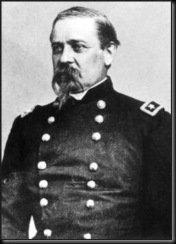 Things were even more confused for the men of the XVIII Corps, led by the venerable General William F. “Baldy” Smith. Smith was known as a good, solid soldier and was a favorite of Grant’s. He also was a very forthright officer who never hesitated to say exactly what he thought. His corps was also ordered to move to Cold Harbor, but they were at White House and, since they had not yet entered the Army of the Potomac’s area of operations, Grant gave the order for their movement. However, Grant’s staff made an error in the orders and told Smith to move to the New Castle Ferry, not to Cold Harbor, and to form up next to VI Corps when he arrived there. Receiving the orders in the early morning hours of June 1st, Smith sensed their urgency and hurried his command forward without any breakfast. However, when he arrived at New Castle Ferry, he could not find the VI Corps since he was still some five or six miles away from Cold Harbor. Soon, an officer from Grant’s staff arrived and told him of the error. Smith moved his men out quickly but they did not arrive at Cold Harbor until the early afternoon.
With Sheridan’s men having been replaced by the exhausted infantry of Wright and Smith, Meade ordered Hancock’s II Corps to also pull out of the line and begin moving towards Cold Harbor. Shortly thereafter and to the surprise of many, Meade decided to order a frontal assault on the Confederate forces digging in opposite Smith and Wright. Perhaps he was trying to prove to Grant that he too could be an aggressive fighter. If Grant wanted a big push against Lee here, Meade would go ahead and try to give him one.
Between Wright and Smith’s corps, Meade had six divisions to use against the two Confederate divisions dug in opposite the crossing, so the military odds looked good. However, the infantry were tired from their forced marches and there had been only been time for a “hasty reconnaissance” of the ground in front of the Federal lines. At 4:30 P.M., the worn out infantry attacked. The fighting was fierce and the blue-clad infantry did manage to sweep over the enemy rifle pits and then seize the main Confederate trenches. But a strong Southern counterattack forced them back. It had been a useless bloodletting that did little except to provide some small reconnaissance on enemy strength and positions. Emory Upton wrote that it was an example of the poor generalship during the campaign and that the various corps commanders were “not fit to be corporals. Lazy and indifferent, they will not even ride along their lines; yet, without hesitancy, they will order us to attack the enemy, no matter what their positions or numbers.”
With nightfall, things in the Army of the Potomac became even more unsettled and Meade began to show signs of stress and fatigue. Theodore Lyman recorded that Meade “was in one of his irascible fits to-night.” Meade complained that Warren and his corps had pushed too far forward without orders, vented that Wright was too slow, and then said he wished the corps commanders would act for themselves and stop leaning on him. In the midst of all this ranting, an aide to General Smith arrived to report that his commanding officer was in serious need of ammunition and transportation, and that General Smith “considered his position precarious.” Using profanity he seldom uttered, a clearly exasperated Meade roared, “Then, why in Hell did he come at all for?”
Later, he instructed Smith to be ready for an early morning assault. However, Smith cautioned him that his command was not up to such an attack, terming the prospect “simply preposterous.” Soon, Meade discovered he had more problems than Smith’s concerns. Meade had been counting on the presence of the tough, hardened veterans of Hancock’s II Corps to mount the early morning attack. Unfortunately, their night march to Cold Harbor was going worse than that of Wright the previous evening. II Corps became hopelessly lost and, at one point, the engineer sent to guide them took the corps down a supposed short cut that proved to be so narrow, Hancock’s artillery could not use the road. As a result, his command was forced to backtrack and find another route, causing “great confusion.” As a result, Hancock’s troops would not arrive until 6:30 A.M.
Learning of Hancock’s lack of progress, at 12:30 A.M., Meade issued an order that the attack would be postponed until 5:00 P.M. on June 2nd. But all these delays were adding to another of the concerns that Meade expressed: Lee was getting the time to shift his forces and dig in. The ability of Lee’s army to quickly erect field fortifications was a skill that the Army of Potomac had seen demonstrated repeatedly.
Despite the delays, after discussing the issue with his key commanders, Grant still decided that attacking Lee in his present position was the best course of action. According to Horace Porter, Grant surmised that, first, he had broken the enemy at other places “under circumstances which were not more favorable” and that, if they could do so now, the results obtained would justify the decision. Porter also maintained that Grant viewed the decision to attack from a broader perspective and that the general was keenly aware that the Northern populace was becoming discouraged by the length of the war. Therefore, a decision at this point to maneuver south of the James River towards Petersburg would be seen as indefinite in nature and feed the population’s growing impatience.
Concerned that Hancock’s men were not up to an attack that afternoon, Grant advised Meade to delay the assault until the early morning hours of June 3rd. On the negative side, this decision resulted in more delay and provided yet more time for Lee’s army to entrench and reinforce. On the positive side, Meade’s order did direct commanders to conduct a reconnaissance of the ground in front of their positions. This not only would tell them the nature of the terrain between Union and the Confederate lines, but it also, hopefully, would aid in determining the makeup of the enemy’s fortifications. However, no such reconnaissance ever took place. This is one of the great command mysteries surrounding Cold Harbor. It seems inconceivable that experienced commanders would violate what any soldier, then or now, would see as a crucial element of battlefield preparation. It is of significance that, when Meade later relayed his orders to Burnside and Warren regarding their attacks on the Confederate left, he never reemphasized this need for reconnaissance. In fact, what is perhaps even more significant is that neither Grant, Meade, nor any of the corps commanders ever followed up to determine what results had been obtained from reconnaissance activities.
Hancock’s adjutant, Francis Walker, later wrote that there had been no opportunity to “make an adequate reconnaissance of the enemy’s line…it was, beyond question, the most unfortunate decision made during that bloody campaign.” The fact that Hancock’s adjutant made this comment is telling. Meade’s circular had been clear in that it stated commanders should use the additional time to examine the ground in front of them. So, why did Walker state that there had been no opportunity and why did no other commander make any effort at a reconnaissance? Time should not have been a problem since the circular went out at 2:30 P.M. and there was more than enough daylight left before nightfall to probe the Confederate positions.
Historian Bruce Catton maintains that it was merely assumed this reconnaissance would be done as a matter of routine. However, he states that corps routine in the Army of the Potomac “did not extend to such matters.” As a result, in Catton’s words, “40,000 men in three army corps were to begin marching towards Richmond at dawn. What they were going to run into along the way was something they would have to find out for themselves."
The only real reconnaissance was that made during the fighting late on June 1st, and much had probably changed. The heavy woods between the Union and Confederate positions limited the troops’ ability to even see the enemy positions. All that was known was that there was evidence that field fortifications had been prepared. Their nature, their orientation, and the strength of the enemy were totally unknown. So, all that could be seen was some turned earth and that was what they would attack. Unfortunately for the Army of the Potomac, the freshly dug earth they could see included rifle-pits, and not one main line of trenches, but two and even three in some places. Lee and his men had skillfully placed their fortifications so that they followed the uneven terrain and made maximum use of its natural characteristics.
The other odd thing about the planning for the assault was that each corps was seemingly left on its own to determine how it was going to attack, with no plans for cooperation. Smith said that the entire concept made it apparent to him that there was no semblance of a military plan involved. So, he sent a message to General Wright asking him to explain his plan of attack for VI Corps. Smith reasoned that, since VI Corps would be on his left, perhaps, he could do something to conform to their plan. To Smith’s shock and dismay, Wright replied that his plan was simply to “pitch in.” Therefore, Smith realized his only option was to do the same, charge straight ahead, and see what happened.
Colonel Charles Wainwright, who served in Sheridan’s cavalry at the time of the campaign, heard about the attack and the lack of planning in the days after the battle. He would comment in his diary that, “there was a still more absurd order issued, for each command to attack without reference to its neighbors, as they saw fit; an order which looked as if the commander, whoever he is, had either lost his head entirely, or wanted to shift the responsibility off his own shoulders.” Clearly, any remaining semblance of command cohesion was gone.
However, what some of the senior officers could not see, the average soldier could clearly comprehend. One soldier recalled that, “We knew that a bloody battle was close at hand, and instead of being elated the enlisted men were depressed in spirit.” Some of his comrades were “sad, some indifferent; some so tired of the strain on their nerves that they wished they were dead and their troubles over.” Their clear impression was that the task cut out for them was more than men could accomplish.
That night, as he toured the camps, Horace Porter observed something that has been often told about the night before the attack at Cold Harbor. It said much regarding what the average soldier knew about the next day’s fight and about what his commanders could not see. Porter reported that men were sewing their names and home addresses onto their uniform jackets so that, when they fell, their bodies could be recognized and their fate made known to their families at home.
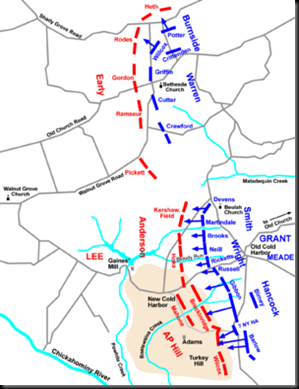 In the darkness preceding dawn of June 3rd, all five corps of the Army of the Potomac began to form up in a long, almost unbroken line. The concept for the attack was simple but without any solid military logic. The II, VI, and XVIII Corps would conduct the main attack on Lee’s right. Meanwhile, V and IX Corps under Warren and Burnside, respectively, would attack the left of the Army of Northern Virginia in order to hold the units there in place and prevent Lee from transferring them to help hold the right side of his line. The only coordination in this plan was that everyone would attack at 4:30 A.M.
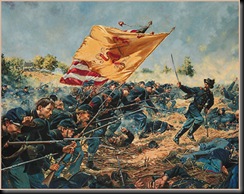 At the appointed time, a signal gun sounded, and the Army of the Potomac stepped off in a heavy mist and fog to attack Lee’s army. Within minutes, as the first wave moved forward, the heavy vegetation and previously unseen swamps and wetlands began to break up the neat formations and, even within each corps, any appearance of a coordinated attack disappeared. Thus, the assault quickly became a collection of uncoordinated, isolated, individual actions. Further, as the five corps moved forward and the Confederate fortifications came into view, each began to square up with the works at their front. Given the configuration of Lee’s lines and because they had not previously reconnoitered the ground, this caused the Union formations to depart off at odd angles from one another and each corps began to lose contact with the units next to them. As a result, when the Confederates opened fire, they were able to enfilade the Union attackers with devastating effectiveness.
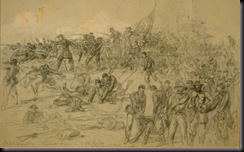 In a war that had seen more than its share of slaughter, Cold Harbor would set a new and terrible standard. The Union forces advanced under a storm for rifle and artillery fire, and the men went down in groups. In the course of the first hour, two waves went forward and only Francis Barlow’s division of Hancock’s corps actually met with success. They managed to seize and hold a portion of Lee’s far right. But here, again, command failed. Despite Barlow’s repeated requests, Birney’s division, which was in reserve, stayed where it was, and was never ordered to move forward to exploit what Barlow’s men had gained. The remaining four Union corps went forward, some getting further than others, until the withering fire from Lee’s entrenchments slowed, stopped, and eventually pinned the Federals down. The embattled soldiers simply dug in where they were and tried to survive.
 Command communications were confused and there was no control over the attack. Meade and his staff were oddly disconnected from the battle because the woods filtered the noise of battle and, thus, they had no feel for what was happening. Theodore Lyman wrote, “There has been no fight of which I have seen so little as this. The woods were so placed that the sound, even of the musketry, was much kept away, and the fighting, though near us, was completely shut from view.” The reports that came into Meade’s headquarters conveyed a confused picture and, soon, the lack of prior planning and coordination became apparent. Each of the three corps commanders on the Union left now complained to Meade that the corps on his right or left had failed to protect him from enfilading fire. Meade’s curious response to this situation was to send copies of each corps commander’s complaint to the others. Meade kept trying to urge his commanders forward but they became increasingly insistent that nothing could be done. Hancock became especially exasperated with Meade’s requests to continue the assault, telling him “Unless success has been gained in other points, I do not advise persistence here.”
At 7:00 A.M., with attacks failing up and down the line, Meade sent Grant a message advising him that, ”I should be glad to have your views as to the continuance of these attacks, if unsuccessful." This dispatch, in some ways, seemed to indicate that Meade was surrendering his control back to Grant.
Grant replied quickly and stated what would seem to be obvious: “The moment it becomes certain that an assault cannot succeed, suspend the offensive, but when one does succeed push it vigorously, and if necessary pile in troops at the successful point from wherever they can be taken.” With that dispatch sent, Grant moved to Meade’s headquarters and, for all intents and purposes, once again took tactical control of the Army of the Potomac.
Grant had been nearby at his headquarters and was apparently receiving the same reports as Meade. In addition, his staff went out to ride the lines and gather information, which they funneled back to the general-in-chief. However, things were happening faster than they could report them. After moving to Meade’s headquarters, Grant decided to ride out to the lines himself and consult directly with Meade’s corps commanders. This action could leave no doubt as to who was now in command. Grant returned to Meade’s headquarters and, at 12:30 A.M., he issued an order suspending the assault: “The opinion of corps commanders not being sanguine of success in case an assault is ordered, you may direct a suspension of farther advance for the present. Hold our most advanced positions, and strengthen them.”
Later in the afternoon, an order would be sent out to try another assault, but the reaction it received varied. There were some isolated moves forward but they apparently amounted to nothing more than some brief heated exchanges of rifle fire. For his part, Baldy Smith flatly refused to obey the order and, interestingly, was never sanctioned for it. Finally, while some senior officers would deny it ever happened, there were units who simply refused to advance. One soldier witnessed this amazing event and later wrote, “The army to a man refused to obey the order, presumably from General Grant, to renew the assault. I heard the order given, and I saw it disobeyed." The common soldier had put in his vote and the battle for the crossing at Cold Harbor was over.
Grant’s initial report to General Henry Halleck, sent at 2:00 P.M., was shocking in its understatement of what had occurred:
We assaulted at 4.30 o'clock this morning, driving the enemy within his intrenchments at all points, but without gaining any decisive advantage. Our troops now occupy a position close to the enemy, some places within 50 yards, and are intrenching. Our loss was not severe, nor do I suppose the enemy to have lost heavily. We captured over 300 prisoners, mostly from Breckinridge's command.
However, the magnitude of what had occurred and the ghastly cost of this command blunder would soon become apparent. While the exact number of casualties has become an item of modern debate, no matter their total, it had been an unmitigated disaster. Theodore Lyman recorded that; “We gained nothing save a knowledge of their position and the proof of the bravery of our soldiers.” That night, Grant finally made his feelings known to his staff: “I regret this assault more than any one I have ever ordered. I regarded it as a stern necessity, and believed it would bring compensating results; but, as it has proved, no advantages have been gained sufficient to justify the heavy losses suffered.” With that said, as was his manner, Grant focused his energies on planning his next moves and seldom spoke of Cold Harbor again. However, the simplest and most telling description of the slaughter at Cold Harbor was made by Confederate General Evander Law who wrote to his wife after the battle that, “It was not war, but murder.”
There was a profound change at Grant’s headquarters following the June 3rd assault at Cold Harbor. Colonel James Wilson described it as a sense of despondency. Wilson said that Grant was deeply disappointed he had not been able to overwhelm Lee and was upset that his subordinates had not properly attended to the detailed planning required to carry out his orders. According to Wilson, Grant was now aware that, perhaps, this was being done so as to shift responsibility to him. In addition, his staff was now seeing the disastrous effects of the continuous use of frontal assaults and feared the army would come apart if this approach continued. One thing was certain: the cockiness that had been the hallmark of Grant’s staff when the campaign began was now gone and a numb sense of harsh reality had set in.
For his part, Meade seemed to take an entirely petulant attitude. In a meeting with Baldy Smith two days after the battle, he told his corps commander that he had worked out every plan for every move since the campaign began. He then complained about the newspapers being full of the activities of “Grant’s army” and that he was tired of it. He finished by saying that he was now “determined to let General Grant plan his own battles.” Smith wrote that, while he had “no knowledge of the facts,” he had “always supposed that General Grant’s order was to attack the enemy at 4:30 A.M. of the 3rd, leaving the details to his subordinates.” In other words, Smith believed that Meade simply did not try to execute Grant’s orders properly because he was angry about his treatment by Grant and by the press. Whatever Meade’s thinking had been, the result was that, at Cold Harbor, no one was in effective command of the Army of the Potomac.
The ultimate tragedy of Cold Harbor was that it was so avoidable. The Army of the Potomac did not fail on June 3rd. Rather, its leadership failed and failed miserably. Thousands of brave men died because an unworkable command system had been allowed to remain in place long after it was apparent that it was impractical. Worst of all, however, is that, as that structure broke down, so did professional conduct among its key officers.
Ulysses S. Grant should have seen the trouble coming. He had put a system in place wherein no one was quite sure who was in command of the Army of the Potomac. Then, he had complicated that picture through words and actions that indicated he was truly in command. Given the situation, perhaps there was nothing Grant could have done to have earned the trust of the Army of the Potomac’s leadership, but the actions of he and his staff made things worse than they should have been. For his part, George Meade, while subordinate in public, felt abused and seethed at the attention Grant got from the press. What he did not understand was that Grant paid little attention to such things as praise from the newspapers, and, perhaps, Grant did not realize how much it affected others. However, once given tactical control, Meade proved to be either, at best, incompetent or, at worst, guilty of gross professional negligence.
Then there are the actions of Hancock, Wright, and the other corps commanders at Cold Harbor. How could they let their men attack with no knowledge of lay ahead of them? With the exception of Baldy Smith, not one of them made even the slightest pretense of a protest. Perhaps it was stress, fatigue, and the fact these men simply had seen so much death, so many bloody frontal attacks, that they viewed this as just another order to be carried out no matter the cost. It was as though the attack was a terrible predestined act which none of them had the power to influence.
 Cold Harbor was, indeed, a failure of command. It is a horrible example of what happens when command cohesion breaks down under the weight of an unworkable system, when the stress of battle overcomes professionalism, and when otherwise good officers forget the basics of command and their responsibilities as commanders. In the end, their men, the average soldiers, paid the ultimate and terrible price.


 Posts
Posts


